Wednesday, October 17, 2007

IHS Press Releases Storytelling Book


With the publicatin of The Scenice Route: Stories from the Heartland, the Indiana Historical Society Press celebrates the twentieth anniversary of Storytelling Arts of Indiana, which promotes the art and use of storytelling in everyday life through its annual festival, concerts, workshops, programs, and other events.

Storytelling is about gathering with freinds, family, and even those we have just met to share with one another stories of our childhood, our culture, and our heritage. In this age of over-scheduled lives, Internet and television addictions, and outside pressures, stories remind us of our roots and traditions.

Storytelling Arts of Indiana has spent twenty years creating places for individuals to come together and experience storytelling in the hope of encouraging that sharing and listening relationship in our everyday lives. The Scenice Rout offers the reader a dozen stories to enjoy and to help us remember.

The books costs $8.95 and is available from the Society's Basile History Market. To order, call (800) 447-1830 or order online at the History Market.

Youth Biography Examines Hoosier Suffragist


Famed Indiana author Booth Tarkington once took on the task of naming three of Indianapolis’s most outstanding citizens. Two of the three he named—former president Benjamin Harrison and legendary poet James Whitcomb Riley—were well-known people. The third, however, was someone whose memorable accomplishments have become lost to history—educator, woman’s rights pioneer, and peace activist May Wright Sewall.

Written by award-winning author and historian Ray E. Boomhower, Fighting for Equality: A Life of May Wright Sewall, a biography aimed at young readers, showcases Sewall’s important contributions to the history of Indianapolis, Indiana, the United States, and the world. A woman who had the “organizing touch,” Sewall helped to establish such Indianapolis institutions as the Girls’ Classical School, the Indianapolis Woman’s Club, the Contemporary Club, the Art Association of Indianapolis (today known as the Indianapolis Museum of Art), and the Indianapolis Propylaeum.

Sewall also worked tirelessly on behalf of rights for women in the United States—and around the globe—during the late nineteenth and early twentieth centuries. She served as a valuable ally to such national suffrage leaders as Susan B. Anthony and Elizabeth Cady Stanton and gave the woman’s movement an worldwide focus through her pioneering involvement with the American National Council of Women and the International Council of Women.

After working on behalf of peace as a delegate on millionaire automaker Henry Ford’s failed Peace Trip in 1915, Sewall shocked her friends by releasing a book telling of her communications beyond the grave with her deceased husband, Theodore Sewall. She related her remarkable experiences with spiritualism in her book Neither Dead nor Sleeping, published by Bobbs-Merrill of Indianapolis in 1920 just a few months before Sewall’s own death.

Fighting for Equality: A Life of May Wright Sewall costs $17.95 and is available from the Society's Basile History Market. To order, call (800) 447-1830 or order online at the History Market.

Tuesday, September 04, 2007

Interview with Vietnam Memoir Author

Jim McGarrah teaches teaches creative writing at the University of Southern Indiana, where he is an assistant professor in the English department. Here he answers questions about his new book A Temporary Sort of Peace: A Memoir of Vietnam, recently released by the Indiana Historical Society Press.

For many, the Vietnam War is still too fresh and too painful to read about or see in movies or on TV. What’s your experience with this?
I think a testament to these memories remaining fresh and painful for everyone concerned is the time lapse between when I returned from Vietnam in 1968 and when I actually began my career as a writer trying to come to terms with some of my ghosts in 1998. It took three decades and considerable therapy for PTSD (post-traumatic stress disorder) before I was willing to take on the frightening and often retraumatizing challenge of reflecting on what had happened to all of us in that generation.

How well do you think that movies, books, TV programs, etc. have done thus far in portraying the realities of that war?
There have been some brilliant books written on the subject, including poetry collections, but almost exclusively by people who have had firsthand experience with the Vietnam War. These are books that adhere to Tim O’Brien's famous adage: “you can tell a true war story by its uncompromising and absolute allegiance to obscenity and evil.”

Movies tend to drift away from that because we Americans like to see positive resolution in our Hollywood dramas. The good guy needs to win before we feel like we got our money’s worth and Hollywood caters to that shallowness; TV caters to it even more. Consequently, with those mediums the concern is often more economic success than honesty. There are exceptions. Born on the Fourth of July and Full Metal Jacket were both overwhelmingly real and honest. Apocalypse Now, which was also a great movie, may have been the most real because of its surreality--that vague shadow of existential malaise and then the blatant insanity that ran through every scene.

How have they misrepresented things?
One has only to watch Rambo or any of Chuck Norris’ Vietnam movies to understand the answer to that question. One Vietnam veteran is not equal to 50 other men. Rifles do run out of ammunition. American grenades don’t blow up bad guys and leave innocent people alone.

The Vietnam War was part of a political agenda and, as an exercise in “flexible” warfare, had nothing to do with patriotism or justice, as the movies and some books might lead you to believe. As a matter of fact, that may be the most tragic misrepresentation because it makes it easier for politicians to manipulate the public into new wars, like Iraq.

You say that “the jungles of Vietnam, the one place where life was at its best and worst simultaneously every minute of every day.” Briefly explain that sentiment.
There really is no brief answer to that question. It’s a complex and guilt-ridden psychological fact. We are taught that killing is wrong and every fiber of our consciousness rebels against that act. On the other hand, a firefight that a soldier lives through often brings a high, an adrenalin rush that creates a subconscious, sometimes addictive, feeling of euphoria. It’s hard to lie to yourself and not admit it’s one of the greatest physical sensations you’ve ever had. So, when you live through a firefight in which others die, you’re psyche is horribly conflicted with both guilt and joy-–the best and worst of life at the same time.

Has writing this book and going back to Vietnam been healing for you? Has it given you peace?
As the title indicates, there is nothing for combat veterans other than a temporary peace, an island of respite that lets your mind rest from time to time from itself. In that regard, the book and the trip both allowed me some rest at the completion of each.

What is your greatest hope for what people will take away from reading this book?
I hope that people will take away from this book how easy it is in our society to manipulate support for dubious causes and that we all, as free citizens, need to demand more accountability from our leaders when they sacrifice our only treasure, the young. But, that we also need to demand more from ourselves in terms of critical thinking about issues before we allow politicians to send our children to war. War has always got to be the very last option on the table when countries have differences. Too often, it’s been the first.

Friday, August 31, 2007

Vietnam Memoir Available


Growing up in Princeton, Indiana, during the 1950s, Jim McGarrah spent his days pursuing dreams of athletic glory on the baseball diamond, becoming captain of his high school’s baseball team and winning, for a time, the affections of a blond cheerleader, escorting her to dates at the local drive-in in his 1957 Chevrolet Bel Air. Although he earned a baseball scholarship to college, McGarrah flunked out of school in May 1967 and, on the way home, enlisted for service in the U.S. Marine Corps, causing his father, a veteran of World War II, to warn him he had no idea what he had just done.

In his new memoir A Temporary Sort of Peace, recently published by the Indiana Historical Society Press, McGarrah, today a poet and writer from southern Indiana, examines in detail his peacetime life in Indiana, his indoctrination into the cult of the marines as a fledgling warrior in basic training at Parris Island in South Carolina (“a small cog of the ‘lean green fighting machine,’” McGarrah notes in the book), and his introduction to the life of a combat soldier in Vietnam observing bulging body bags at an air base’s morgue in Da Nang and going to his first assignment armed with a malfunctioning M-16 rifle. Many years later, the former private first class, serial number 2371586, realized that for him, home had become “the jungles of Vietnam, the one place where life was at its best and worst simultaneously every minute of every day.”

The book also includes the author’s days with a small marine Combat Action Group trying to win the hearts and minds of Vietnamese in the village of Gia Le, his wounding by shrapnel from a rocket-propelled grenade during the height of the Tet Offensive, and dealing with his war memories back home in the United States. In August 2005, at the age of fifty-seven, McGarrah returned to Vietnam, visiting the sites of his former battles with his son and sharing memories of the past and future with a Vietnamese poet in a graceful peace ceremony in Hue.

McGarrah teaches creative writing at the University of Southern Indiana, where he is an assistant professor in the English department. He is the author of an award-winning poetry collection, Running the Voodoo Down; the novel, Going Postal; and served as co-editor with Tom Watson of the Indiana Historical Society Press collection Home Again: Essays and Memoirs from Indiana. McGarrah serves as poetry editor of Southern Indiana Review and is co-director of the RopeWalk Readers Series.

The book costs $19.95 and is available from the Society's Basile History Market. To order, call (800) 447-1830 or order online at the History Market.

Tuesday, August 14, 2007

Interview with Nicholson Biographer


Ralph D. Gray is professor emeritus of history at Indiana University–Purdue University at Indianapolis and founding editor of the Journal of the Early Republic. He is the author of the new IHS Press biography Meredith Nicholson: A Writing Life. He recently answered a few questions about Nicholson.

What drew you to writing about Nicholson?
When I compiled a “reader” on Indiana history in 1979-80, I realized that only Meredith Nicholson, among Indiana’s Big Four writers, had no biography. So I looked into filling that gap. But when I started, I found another person, a Butler professor, also trying to fill the gap, but her work, eventually completed shortly before her death, has not been published. So Ray Boomhower gave me a second chance, more than 20 years later, to resume my Nicholson study and contribute to the Indiana Biography Series.

What’s the most interesting thing you learned during the writing of this book?
I suppose two things. First would be fascinating details about his personal life (both triumphs and tragedies--his father’s suicide, the loss of his first wife in 1931, after which no more novels were written, and much more) and the quality of his writings besides his novels--short stories, trenchant social and political commentary essays and good poetry.

What do you wish more people knew about Meredith Nicholson?
First of all, I’d like people to recognize Nicholson’s humor, sly and understated, but omnipresent. I also think his life story is fascinating, given his lack of formal education and a difficult home life, but he persevered and did outstanding work in at least four areas--as a newspaperman, a poet (an unlikely close friend, Riley, was his idol), a novelist and a diplomat. He was also a good businessman, but he disliked such work.

That flap copy for the book says “Nicholson stands as the most Hoosier of all Indiana writers, serving as an outspoken advocate for his state.” Give an example of what makes this true.
The totality of his writings--as I say somewhere, he never failed to boost all things Hoosier, and he repeatedly sprang to his state’s, and to his adopted city’s, defense if he detected a slight by someone.

What can we learn from Nicholson?
As he himself said in an autobiographical essay, “Without Benefit of College” (which could have been titled “Without Benefit of High School”), he was not bragging but wanted to assure parents concerned about their children’s lack of success in school, that there were other ways a person, if properly self-motivated and diligent, could make their way in society. Obviously, too, I hope people will think of Nicholson as a true, worthy member of the Big Four, not the one often forgotten in listing them all.

Monday, August 13, 2007

Press Publishes Nicholson Biography


From 1880 to 1920, Indiana experienced a golden age of literature, with Hoosier authors achieving both national prominence and national acclaim. These writers provided readers with stories that emphasized traditional values and offered shelter from an ever-changing world.

Although those who lived in the state took an immense pride in what Indiana writers produced, they heaped special attention on four men, including the great Hoosier poet, James Whitcomb Riley; Pulitzer Prize–winning novelist Booth Tarkington; and noted newspaper columnist and humorist George Ade. The other member of this special group—Meredith Nicholson—also won enormous success with his novels. As Ralph D. Gray notes in this first-ever biography of the author and diplomat, Meredith Nicholson: A Writing Life, the fifth volume in the Indiana Historical Society Press’s Indiana Biography Series, Nicholson stands as the most Hoosier of all Indiana writers, serving as an outspoken advocate for his state. Indiana literary historian Arthur S. Shumaker called Nicholson the “most rabid” of Indiana’s major authors.

In addition to writing such national best sellers as Zelda Dameron and The House of a Thousand Candles, his best-known work, Nicholson won praise as an insightful essayist, with his work published in such national magazines as the Saturday Evening Post and Atlantic Monthly. “Nicholson’s enduring faith in ‘folks,’ the ordinary people of the Ohio and Mississippi valleys and the Midwest, his inherent belief in democracy and democratic values, and his unapologetic patriotism permeate his essays,” notes Gray, “some of which excoriated the Ku Klux Klan and upheld the rights and virtues of women, attitudes not always popular at the time.”

A longtime supporter of the Democratic Party, Nicholson’s loyalty to his party was rewarded in 1933 when President Franklin D. Roosevelt appointed him to be America’s top diplomat in war-torn Paraguay. Nicholson gave able service to the United States and went on to serve in two other Latin American countries before retiring from public life in 1941.

The book costs $19.95 and is available from the Society's Basile History Market. To order, call (800) 447-1830 or order online at the History Market.

Friday, August 10, 2007

History and Genealogy

At the Midwestern Roots Conference, co-sponsored by the Indiana Historical Society and the Indiana Genealogical Society in August 2005, a special session was held, "History and Genealogy–Why Not Both?"

Participants in the session included professional genealogists Elizabeth Shown Mills and Tony Burroughs, archival manager Curt B. Witcher, historians Marianne S. Wokeck and James H. Madison, and the session was introduced by historical editor M. Teresa Baer of the IHS Press. All participants are also published authors. Three of the participants, Mills, Witcher, and Baer, submitted papers based on the discussion to the Indiana Magazine of History, published by Indiana University. The editors of the IMH published all three papers on the periodical's Web site. The link to them is at the top, left side of the home page. The end of the introductory paper (Baer’s) includes a call for comments. The participants and the editors of the IMH welcome comments and hope the publication of these articles furthers the discussion and fosters closer ties between the scholarly pursuits of genealogy and history.

Monday, July 02, 2007

District Court History Published


Since Indiana’s inception as a territory under the Northwest Ordinance, the federal courts held here over the last two centuries have played an important and distinguished role in both local and national legal history. This significance is vividly represented in Federal Justice in Indiana: The History of the United States District Court for the Southern District of Indiana. From its earliest days as a territorial court to the District Court’s current composition, the people and places central to the conduct of the court’s business are placed into the wider context of Indiana and American history.

Authors George W. Geib and Donald B. Kite Sr. provide the reader with an understanding of both the organizational structure of the court as well as glimpses into the cases, both great and small, which have come before it. The discussions on the court’s structure allows for insight into the selection and appointment of judges, contextualizes the constitutional basis of the court’s authority, and makes the politics and administration of federal justice in Indiana comprehensible.

The variety of cases that Geib and Kite include in the text illustrates the evolution of the court. More importantly, these cases lend a sense of humanity to the court, as those individuals involved with the trials and hearings are brought out of the shadows of legal history to stand as witnesses to the court’s past. From the famous Ex parte Milligan case to the modern court’s rulings on religion, pornography, and civil rights, the significance and influence of the federal judiciary in Indiana is clarified.

Federal Justice in Indiana is an important addition to the growing collection of books on American legal history and a valuable resource to those interested in Indiana history. With its balanced handling of legal, social, and political issues, this book will appeal to attorneys and non-attorneys alike.

Best Books of Indiana Nominations

Two IHS Press books have received nominations in the third annual Best Books of Indiana competiton sponsored by the Indiana Center for the Book, a program of the Indiana State Library. The competition highlights Indiana's ongoing literary successes by recognizing recent books about Indiana or by Indiana authors.

The Press books Evie Finds Her Family Tree by Ashley B. Ransburg, and The Soldier's Friend: A Life of Ernie Pyle by Ray E. Boomhower, are finalists in the children's literature category. The other finalist is Georgie's Moon by Chris Woodworth, published by Farrar, Straus, and Giroux.

Winners in the children's literature, fiction, non-fiction, and poetry categories will be announced at an awards ceremony from 3 p.m. to 4:30 p.m. on Thursday, July 19, in the Authors Room at the Indiana State Library, 140 N. Senate Ave., Indianapolis.

The purpose of the Indiana Center for the Book is to stimulate public interest in books and reading at the state and local levels and to encourage the study of books in society. The Indiana Center serves as an affiliate with the Center for the Book in the Library of Congress to promote books and reading through programs, discussion groups, lectures, and exhibitions throughout the state. The Indiana Center also represents Indiana at the National Book Festival in Washington, D.C. each year.

The Indiana Center for the Book is a program of the Indiana State Library, with an advisory group consisting of representatives from the Indiana Humanities Council, the Indiana Library Federation, the Writers' Center of Indiana, the Indiana Historical Bureau, the Indiana Arts Commission, and the Indiana Historical Society.

Wednesday, June 06, 2007

Foreward Magazine Honors Press Title

The IHS Press book Abraham Lincoln Portrayed in the Collections of the Indiana Historical Society received a silver prize in the regional category of ForeWord Magazine's 2006 Book of the Year Awards.

A panel of judges composed of librarians and booksellers named 216 winners, narrowed from nearly 1,400 entries, representing the finest work from today’s vibrant independent publishing community. The winners were announced at a ceremony Friday, June 1, at BookExpo America in New York City.

Wednesday, April 18, 2007

Pyle Youth Biography Honored

The IHS Press youth biography The Soldier's Friend: A Life of Ernie Pyle has been named as one of three finalists in the 2007 Benjamin Franklin Awards competition. The book is a finalist in the Juvenile, Young Adult Nonfiction, category.

The 2007 Benjamin Franklin Award winner will be chosen from one of the three finalists and will receive the Benjamin Franklin Award during a ceremony on Thursday evening, May 31, 2007, at the Park Central New York, located at 870 Seventh Avenue at 56th Street in New York City.

Sponsored by the Publishers Marketing Association, an independent book publishers association, the Benjamin Franklin Awards recognizes excellence in independent publishing. Publications, grouped by genre are judged on editorial and design merit by top practitioners in each field. The trophies are awarded to the best books in several categories and are presented to the publishers during a gala awards ceremony on the last evening of the Publishing University (just before the opening of Book Expo America).

Written by Ray E. Boomhower, The Soldier's Friend: A Lifer of Ernie Pyle explores the reporter’s legendary career from his days growing up in the small town of Dana, Indiana, to his life as a roving correspondent with the Scripps-Howard newspaper chain, to his growing fame as a columnist detailing the rigors of combat faced by the average G.I. during World War II. The book also features numerous illustrations, samples of Pyle’s World War II columns, a detailed bibliography of World War II sources, and an index.

Monday, April 16, 2007

New Youth Biography Joins IHS Press Titles


The Indiana Historical Society Press is proud to announce the release of its newest youth biography title, A Belief in Providence: A Life of Saint Theodora Guérin. The book explores the life and legacy of the woman who would become Indiana’s first saint.

Written by Julie Young, A Belief in Providence follows the life of Saint Theodora Guérin (born Anne-Thérèse Guérin in 1798) from her childhood and formative, faith-building years in France to her answer of the call to found a religious establishment near Terre Haute, Indiana. It also details her work as a religious and educational pioneer on the Indiana frontier.

Despite poor health, primitive frontier conditions, and dealings with a contentious archbishop (who at one point locked her in a room in the rectory), Mother Theodore Guérin founded Saint Mary-of-the-Woods College, the oldest Catholic women’s liberal arts college in the United States, and opened schools in Jasper, Madison and Vincennes, Indiana, often facing suspicion and hostility from the local population.

The book also examines the process leading to Guérin’s canonization, from the beginning of the official Cause for her sainthood in 1909 to the culmination of this century-long effort on Oct. 15, 2006.

Young is a freelance writer and adjunct faculty at Indiana University-Purdue University at Indianapolis, teaching creative writing and freelance writing through its community learning network. A graduate of Saint Mary-of-the-Woods College with a degree in professional writing, her work has been seen in various publications, including Indianapolis Woman, Evansville Living and AAA Home and Away magazines as well as CNN.com. She has also worked for the Associated Press, the Herald Weekly newspaper and Scecina Memorial High School in Indianapolis.

The books costs $17.95 and is available from the Society's Basile History Market. To order, call (800) 447-1830 or order online at the History Market.

Thursday, March 08, 2007

Indiana Trivia Book Released


Trivia and the pursuit of the trivial are embedded in American culture. Who hasn't dreamed of winning the million-dollar prize on Who Wants to be a Millionaire?, decimating opponents in a rousing game of Trivial Pursuite, or zinging tidbits in to conversational breaks at social gatherings?

Although knowledge of Indiana trivia will not guarantee an appearance on national television, it can be fun, as Fred Cavinder proves in his new book from the IHS Press titled The Indiana Book of Trivia. The book resists commonly known Hoosier trivia such as Cole Porter was from Indiana or that Don Larsen pitched the only perfect game in World Series history, in favor of listing odder, less historic facts about the Hoosier State and its inhabitants.

Cavinder is a former reporter and editor with the Indianapolis Star. He is also the author of The Indiana Book of Quotes, also published by the IHS Press, and Amazing Tales from Indiana, More Amazing Tales from Indiana, and The Indiana Book of Records, Firsts, and Fascinating Facts, all published by Indiana University Press.

Wednesday, March 07, 2007

New Family History Book Available


Genealogy is history on the most personal level, a quest to discover and share stories about one’s forebears. First-time researchers wonder where to find information and how to compile it. These are the same questions asked by historical scholars seeking to tell community and national stories. Finding Indiana Ancestors: A Guide to Historical Research serves both audiences by providing an overview of research in general while focusing on Indiana-specific sources.

The Indiana Historical Society began compiling this comprehensive guide in 2000, contracting archivists, librarians, journalists, genealogists, and historians in the state’s major historical and genealogical organizations to write about their areas of expertise. The resulting essays appeared first in the Society’s family history journal, The Hoosier Genealogist (upgraded recently to THG: CONNECTIONS). In this book, they come together to form a complete guide for historical research in Indiana.

The book is divided into six parts. Parts 1–3 focus on getting started, working with family stories and pictures, documenting sources in libraries and archives, and understanding different record groups. Parts 4 and 5 explain researching with maps and researching different ethnic groups. Part 6 discusses manuscript and artifact research, nineteenth-century medicinal and industrial history, and data verification. A sample family group sheet and a sample pedigree chart appear in appendixes. Six model chapters show how to turn data into full-fledged stories.

Finding Indiana Ancestors: A Guide to Historical Research will help students, scholars, and family history researchers delve deeply into historical sources. Readers will learn where to go for the next piece of information, how to interpret the data, and how to incorporate each new fact into the stories of our ancestors—the people of Indiana.

The books costs $29.95 and is available from the Society's Basile History Market. To order, call (800) 447-1830 or order online at the History Market.

IHS Press Books Nominated for Awards

Four books published by the Indiana Historical Society Press have been nominated as finalists in ForeWord Magazine's eighth annual Book of the Year Awards.

The IHS Press books and the categories they were nominated in are:
Hoosiers in Hollywood, Performing Arts/Drama
The Governors of Indiana, Reference
My Indiana: 101 Places to See, Travel Guide
Abraham Lincoln Portrayed in the Collections of the Indiana Historical Society, Regional

Nearly 1,400 books were entered in 59 categories. These were narrowed to 698 finalists, from 419 publishers. The winners will be determined by a panel of librarians and booksellers, selected from our ForeWord's readership. ForeWord’s Book of the Year Awards program was designed specifically for them to share in the process of discovering distinctive books across a number of genres with judgments based on their own authority in each category and on their patron/customer interests.

Gold, Silver, and Bronze winners, as well as Editor’s Choice Prizes for Fiction and Nonfiction will be announced at a special program at BookExpo America at the Javits Center in New York City, June 1st from 2:30pm at LIVE@ Second Stage located on the main show floor. The winners of the two Editor’s Choice Prizes will be awarded $1,500 each. The ceremony is open to all BEA attendees.

Tuesday, November 21, 2006

IHS Press Books Honored

Several IHS Press books recently received honors at the Chicago Book Clinic's annual Book and Media Show. Founded in 1936, the Clinic encourages excellence in publishing by providing a platform for educational, social and professional interaction of its members. The Clinic's members are professionals in book and media publishing, printing, editorial, design, and all business aspects of the publishing industry.

The Press received Awards of Excellence (the Clinic's top honor) in the following categories:


Children's, specialty:
Evie Finds Her Family Tree

General Trade, One color and two color internals, non-fiction:
Hoosiers in Hollywood

General Trade, four color internals, non-fiction:
My Indiana: 101 Places to See

Special Trade, gift:
Indiana Sporting Life: Selections from Traces of Indiana and Midwestern History

Monday, October 30, 2006

IHS Press Authors to Sign Books

Authors of books released by the IHS Press this fall will be available to sign copies of their books at a variety of events in November.

Ray E. Boomhower, author of The Soldier's Friend: A Life of Ernie Pyle, will be at the Barnes & Noble store in Plainfield, Indiana, at 7 p.m. on Friday, Nov. 3. The store is located at the Metropolis LifeStyle Center, 2540 Futura Parkway, Plainfield. For more information on the event, call the store at (317) 838-7941.

Boomhower will also talk about his Pyle biography at 7 p.m. on Friday, Nov. 10, at the Culver-Union Township Public Library, 107 N. Main St., Culver. At 7 p.m. on Saturday, Nov. 11, Boomhower will be signing books at Borders Book Store's River Crossing location at 8675 River Crossing Blvd., Indianapolis. For more information on this event, contact the store at (317) 574-1775.

Lou Harry, coeditor of the IHS Press publication The X-Mas Men, will sign copies of the book at 7:30 p.m. Friday, Nov. 10, at the Borders River Crossing location in Indianapolis.

Harry will also be doing a book signing at 7 p.m. on Friday, Dec. 1, at Big Hat Books in Broad Ripple, and at 1 p.m. on Friday, Dec. 8, at the Borders Book Store in downtown Indianapolis.

A host of writers published by the IHS Press will be included in the 90 authors who will be part of the fourth annual Indiana Historical Society Holiday Author Fair from noon to 4 p.m. on Saturday, Dec. 2, at the Indiana History Center, 450 W. Ohio St., Indianapolis.

Visitors can converse with authors, have books signed, and enjoy live entertainment and refreshments. The Holiday Author Fair is free and open to the public.

IHS Press authors who will be at the Author Fair are: Ray Boomhower, Fred Cavinder, Earl Conn, Dan FitzGibbon, Wes Gehring, Angie Goude, Linda Gugin/James St. Clair, Lou Harry, Mary Blair Immel, Jim McGarrah/Tom Watson, Judy Newton/Carol Weiss, Ashley Ransburg, Ray Rice, and David Smith.

Thursday, September 14, 2006

Interview with Pyle Biographer

Ray E. Boomhower, managing editor of the Indiana Historical Society's popular history magazine Traces of Indiana and Midwestern History, is the author of a new youth biography on Ernie Pyle published by the IHS Press. He answered a few questions about writing the book for the Press's blog.

Before starting the project, how much did you know about Pyle's life?

Ernie Pyle has been a part of my life since my college days at Indiana University in Bloomington. I majored in jouralism at IU and spent much of my time in Ernie Pyle Hall, going to classes and, as Ernie did, working on the student newspaper, the Indiana Daily Student. There was something this small, quite man that drew my attention from the first. I marvled at how a kid from small-town Indiana could become so famous and admired him for his devotion to the ordinary GI during World War II.

In doing research on Pyle's life, did you find anything that surprised you?

I knew that Pyle had been a household name in America because of his work during the war, but I was unaware of how popular he had been before World War II. His "Hoosier Vagabond" column for the Scripps-Howard chain reached a wide readership and proved to be one of the most popular features for countless newspapers across the country.

I also did not realize how well Pyle wrote. Like other journalists, he faced enormous deadlines pressures in writing a syndicated column, especially because of his constant traveling. Despite this, he produced quality pieces that stand the test of time.

This is the second youth biography you've written for the Press. [Boomhower also wrote a children's biography of Lew Wallace for the Press.] Do you enjoy writing for a young audience?

It's been a pleasure to research and write these biographies. I've discovered that there's not much difference in writing for young people as compared to writing for an adult audience. Both audiences seem to desire concise biographies of famous Hoosiers that explore the key points of a subject's life. I've also enjoyed ferreting out illustrations for both books in repositories around the state and working with the staff at historic sites devoted to the lives of Wallace and Pyle. They've been a great help in making these books possible.

Wednesday, September 13, 2006

Interview with X-Mas Men Editor

Todd Tobias, publisher of Indy Men’s Magazine, worked with Lou Harry to co-edit the new IHS Press collection The X-Mas Men: An Eclectic Collection of Holiday Essays. Tobias took time recently to answer some questions about the project.


What prompted the editors at Indy Men’s Magazine to do a collection of essays with a Christmas theme?

Indy Men’s Magazine is very much an essay driven publication. What sets the magazine apart from many city and regional publications is that we not only encourage first person writing, it’s more or less the foundation of the magazine. Awhile back we ran a feature called “Father Christmas” in which three of our writers grappled with ghosts from their holidays past. It was well received by our readers and it got us thinking about how an expanded version of that theme--with all of our A-list writers contributing--could make for a really interesting book.

How did you go about recruiting authors for the collection?

We’re fortunate to have a core group of very talented writers who contribute to the magazine on a regular basis. When it came time to recruit authors for this collection we simply asked the writers whose talents we admire the most if they had a holiday story they wanted to tell. We’ve got some real heavy hitters contributing to these pages. Michael Kun was a Pulitzer Prize nominee. Tom Chiarella was a finalist for the National Magazine Award. Phillip Gulley is a best-selling author. Almost without exception all of the writers contributing to The X-Mas Men have authored at least one book.

Do you have a favorite of the essays in the book?

At the risk of sounding like a proud parent I have several favorites that I love for different reasons. I think the book’s real strength is that while each of the essays are distinct in terms of style and subject matter, collectively they create a real universal and cohesive picture of the holidays. Although in a lot of ways, this is more than simply a book about “Christmas.” In a lot of ways it’s a book about family.

What is your most memorable holiday memory?

The essay I contributed deals with a pretty memorable experience. A couple of years ago my daughter, who was four at the time, became really curious about the concept death and the after life. Her curiosity kind of dovetailed with the holiday season. So on Christmas Eve that year I took her to her grandmother’s grave as a way of trying her answer some of her questions. It was an odd way to be spending the early part of Christmas Eve I suppose but it had a big impact on both of us.

Any plans on doing other theme-related books?

Absolutely. We’ve got a got a couple of ideas we’re excited about. We see The X-mas Men as the first in a series of wildly successful books from the writers of IMM.

Tuesday, September 12, 2006

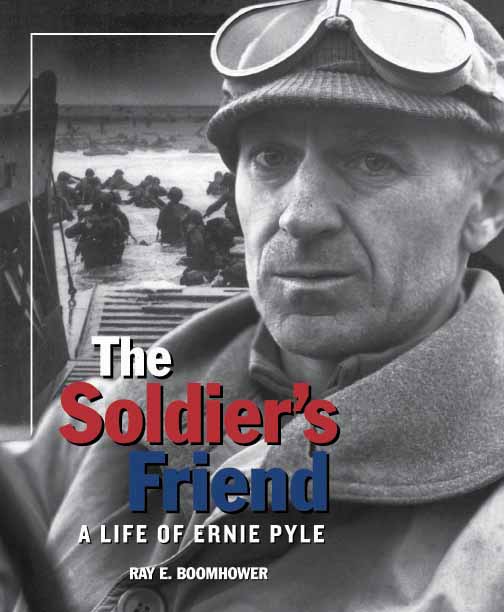
Book Examines Pyle's Life

To the millions of Americans on the home front during World War II, Ernie Pyle’s column in newspapers across the country offered a foxhole view of the struggle as he reported on the life and death of the average soldier. When he died, Pyle’s popularity and readership was worldwide, with his column appearing in 400 daily and 300 weekly newspapers.

Written by award-winning author and historian Ray E. Boomhower, The Soldier’s Friend: A Life of Ernie Pyle, a biography aimed at young readers, explores the reporter’s legendary career from his days growing up in the small town of Dana, Indiana, to his life as a roving correspondent with the Scripps-Howard newspaper chain, to his growing fame as a columnist detailing the rigors of combat faced by the average G.I. during World War II. The book also features numerous illustrations, samples of Pyle’s World War II columns, a detailed bibliography of World War II sources, and an index.

Pyle offered for his readers a “worm’s-eye view” of the war as he reported on the life, and sometimes death, of the common soldier doing the dirty work of fighting in North Africa, Sicily, Italy, and France against the enemy forces of Nazi Germany.

For his distinguished reporting during the war, Pyle received journalism’s highest honor—the Pulitzer Prize—in 1944. Books of his columns were best sellers, and one of his most famous stories, describing the death of an officer named Captain Henry T. Waskow, was made into a movie, The Story of G.I. Joe, starring Burgess Meredith and Robert Mitchum.

John Steinbeck, a best-selling novelist and Pyle’s friend, perhaps best described the reporter’s work when he told Time magazine that there were two wars and neither had much to do with one another. There was the one war that involved maps and the movements of armies, divisions, and regiments run by high-ranking officers such as General George Marshall, chief of staff of the U.S. Army in Washington, D.C.

But there was another war, Steinbeck said. This war involved the “homesick, weary, funny, violent common men who wash their socks in their helmets, complain about the food . . . and bring themselves through as dirty a business as the world has ever seen and do it with humor and dignity and courage—and that is Ernie Pyle’s war. He knows it as well as anyone and writes about it better than anyone.”

The Soldier's Friend: A Life of Ernie Pyle costs $17.95 and is available at the Society's Basile History Market gift shop. To order, call (800) 447-1830 or order online at the History Market.